|

| Max
P. Churchill © Bert E. Kavich
Productions. All Rights Reserved. |
 |
Remember
I Have The Facts!
|
|
|
Jon Thumilson's
dog, Hawkeye, was an important
part of his life. And, as it turns
out, Thumilson was an important
part of Haekeye's life.
After the Navy SEAL was
killed in Afghanistan last summer,
more than a thousand friends and
family attended the funeral in
Rockford, Iowa, including his
"son" Hawkeye, a black Labrador
retriever who, with a heavy sigh,
lay down in front of Tumilson's
flag-draped casket. There, the
loyal dog stayed for the entire
service.
Hawkeye's reaction to his
owner's death generated a lot of
buzz online and in the media. But
it's not unusual, according to pet
experts, for some dogs to mourn
the loss of a favorite person or
animal housemate.
Grief is one of the basic
emotions dogs experience, just
like people, said Dr. Sophia Yin,
a San Francisco-based veterinarian
and applied animal behaviorist.
Dogs also feel fear, happiness,
sadness, anger, as well as
possessiveness.
Dogs who mourn may show
similar signs to when they're
separated for long periods of time
from the individual they're bonded
to, she said. Of those signs,
depression is the most common, in
which dogs usually sleep more than
normal, move slower, eat less and
don't play as much.
The beginnings of such a
strong inter-species bond between
humans and dogs dates back some
15,000 years, when early man and
the ancestor of today's dog roamed
the Earth together.
Today, after thousands of
years of friendship, there's a
great deal of attunement between
humans and dogs, not only in terms
of comprehension of each others
gestures and body language but
also emotionally, said Barbara
King, a professor of anthropology
at the College of William &
Mary in Williamsburg, Va.
It's not just evolutionary
logic, or reading peer-reviewed
science literature that's
convinced King that dogs (as well
as cats) feel deep grief.
Interviews with astute pet owners
for her upcoming book, How
Animals Grieve, and the
power of observation, has also led
her to this conclusion.
Case in point: a grainy
video posted on YouTube that
captured the image of a scruffy
terrier running onto a busy
highway in Chile to rescue another
dog, hit moments earlier, by a
car. As vehicles whiz by the
terrier, he instinctively wraps
his paws around the injured dog,
dragging him off the road to
safety.
"When you look at that sort
of example, again, you see that
these dogs are thinking and
feeling creatures, and that sets
the stage for grief," she said.
Through her research, King
has found that in households with
two dogs who've lived together for
a number of years, some owners
report that when one dog dies, the
other gets depressed. Skeptics
might point to a change in daily
routine as the cause of depression
or, perhaps, because the owner is
upset and grieving. But King feels
differently.
"The surviving dog is
searching around the house for a
lost companion -- looking in
favorite places, going to places
that they spent with their friend,
very pointed actions that tell you
the dog is missing his friend,"
she said.
If a pet mopes around the
house after the death of a canine
or human companion, Yin suggests
the best thing owners can do is to
get their dog's mind off the loss
by engaging their pet in fun
activities
|
Information
source: Above story by
Maryann Mott found in
the July 8th. 2012 issue of The
Arizona Republic newspaper. ( HealthDay
) Section .
|
Max
Links
Flying
Paws
Pet
Portraits by Melanie Phillips
Doggles

Links To
Help The Less Fortunate
To Our
Dear Loving & Generous Friends,
We
ask that you "please" open up your
hearts in helping the poor unfortunate
homeless and their pets. A donation to a
homeless shelter can provide a much
needed meal, clothing and maybe shelter
for these poor people. Won't you
please help? Below we have provided
links to six very reputable and
established shelters who do wonderful
work helping the homeless.
Hesed
House
Phoenix
Rescue Mission

St.
Mary's Basilica
The
American Church In London U.K.
Pets
Of The Homeless
"Our Deepest and Most
Heartfelt Thanks"
Max P. Churchill, Family
& Friends

|

|
|
© Bert E. Kavich Productions.
All Rights Reserved. |
 |
|
|
I Max P.
Churchill stand for the rights of
the working dog who works day in and
day out in many cases without
recognition or appreciation! A dog
who in many cases will literally put
his or her life in jeopardy. A truly
loyal and devoted friend and
companion.
|
|
Max
Commentary
|
|
"Some
Popular Mixed
Breeds"
|
|
If you
think bagels belong to the bread
family, think again. Mix a basset
hound with a beagle and you'll get a
Bagel-without the cream cheese, of
course. Breeders began deliberately
mixing purebreds to create canines
who are mellower and non-allergenic
in the 1980s; now, people are paying
hundreds of dollars for them. The
most popular mixer? The poodle,
prized for its intelligence,
temperament and shed-proof coat.
Whatever the blend, these genetic
cocktails have also given birth to
some silly-sounding names.
Here are a few:
Labrador + poodle = Labradoodle
Pekingese + toy poodle = Pekepoo
Schnauzer + poodle = Schnoodle
West Highland terrier + poodle =
Westiepoo
Golden retriever + poodle =
Goldendoodle
Yorkshire terrier + bichon frise =
Yorki-chon
Pug + beagle = Puggle
Miniature schnauzer + Yorkshire
terrier = Snorkie
|
| The above is
an article written by Meredith
Franco Meyers for the March 2003
issue of Ladies' Home Journal. |
|
|
|
"You
can reach me at the E-mail address
listed below"
bertekavich@mail.com
"Thank You"
|
Mycroft's
Old English Word or
Phrase
of
The Month
Mycroft © Bert E. Kavich Productions.
All Rights Reserved.
Every
month I will share with you a word
with definition or a phrase from
the Old English past which is no
longer in use today.
~
exust
~
To burn;
from Latin exustus,
burned.
|
Information
source: — John Boag's
Imperial Lexicon of the English
Language, c. 1850
|
"Have
A Smashing Good
Day"
Regards,
Mycroft
|
|
If you wish
to contact me you may do so by
sending an E-mail to me at the
address listed below.
bertekavich@mail.com
|
|
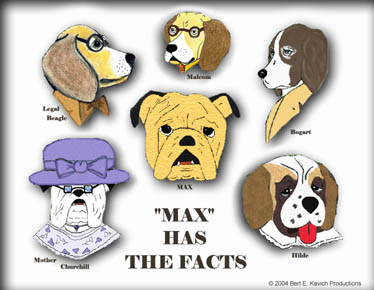
Berton McCoy Beagle
(Legal Beagle), Max P. Churchill,
Mother Churchill, Mycroft, Bogart,
Malcom Pembroke, Hilde,Wilhelmina, Sir
Reginald Fox & Action Bear. Copy
Right 2001-2018 Bert E.
Kavich Productions. All Rights
Reserved.
|

An
Important Notice To Businesses &
Webmasters
To
Place A Link On Any Of Our Main Web Site
Pages - Max
Has The Facts - Legal
Beagle's Report - "Bogart"
Canine Private Eye & Mother
Churchill's Corner There Will
Be A Charge Of $25. U.S. (£17.61
U.K.) A Month. Depending On Size
And Placement Link Prices May Vary.
Banner Prices Will Be Slightly Higher. Please
Send All request & Inquiries To The
Email Address Below.
Only Pet Related Links
Will Be Considered. Also
Any Sites With Adult Content Or
Profanity Need Not Apply!
"Thank
You"
Bert E. Kavich Webmaster/Owner
bertekavich@mail.com
|